Social Dialogue is key to balancing the interests of workers and businesses in industrial relations, while respecting national, cultural and regional traditions. In doing so, it has a track record in promoting quality labour conditions and productive corporations. Social Dialogue is thus an essential element to ensure decent work and economic growth, one the United Nations’ Sustainable Development Goals.
Given the significant challenges that the world of work is currently facing, Social Dialogue needs to re-invent itself to sustain its added value for workers and businesses. The World Employment Confederation-Europe is the recognised, EU Sectoral Social Partner for temporary agency work, representing the employers in the sectoral social dialogue wth UNI Europa.
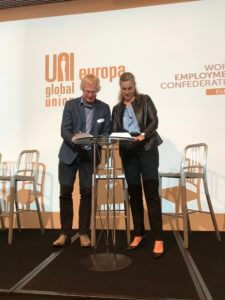
The World Employment Confederation-Europe is the recognised EU sectoral social partner for temporary agency work at EU level and has been engaged in EU Sectoral Social Dialogue since 2001. The counterpart representing workers’ organisations is UNI Europa.
In 2025, a Eurofound study on the representativeness of the European social partner organisations in the temporary agency work sector confirmed that the World Employment Confederation – Europe was the most representative European level social partner organisation representing employers of the sector. This study provides information allowing for an assessment of the representativeness of the actors involved in the European sectoral social dialogue committee for temporary agency work. Their relative representativeness legitimises their right to be consulted, their role and effective participation in the European sectoral social dialogue and their capacity to negotiate agreements.
Every three years, the sectoral social partners agree on a new work programme focusing on different aspects related to regulation of temporary agency work, EU employment policies, capacity building and joint research.
In 2023, the European Union adopted a new initiative to further strengthen and promote social dialogue. The World Employment Confederation-Europe had welcomed the proposals as a way to fully unlock the potential of social dialogue in fostering dynamic, inclusive and resilient labour markets. At the same time, it had some concerns with the proposed review of the rules on the financing of the European Sectoral Social Dialogue Committees. Alongside 30 other European sectoral social partner organisations, WEC-Europe signed an open letter to the European Commission to call for the autonomy of sectoral social partners to be maintained, allowing them to focus on content and their contribution to EU policies.

In December 2024, the World Employment Confederation-Europe and UNI-Europa adopted a new work programme aligned with the strategic priorities of the incoming new European Commission. It will focus on appropriate agency work regulation, skills and employment policies, and strengthening the national social dialogue by sharing good practices to meet the needs and challenges in agency work.
Under this new work programme, the European social partners for the agency work sector aim to continue playing an active role in shaping EU social policies and to conduct joint projects on capacity building and labour mobility.
Through their various projects, the World Employment Confederation-Europe and UNI Europa agreed several joint recommendations and declarations on topics of relevance to the agency work sector, such as:
For more information about each of these joint research projects conducted by the World Employment Confederation-Europe and UNI Europa, visit our page dedicated to the Agency Work sector.